
Outsourcing vs. In-House: Which Is Actually Right for Your Business?
Posted by: Hayat
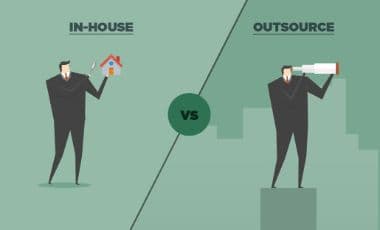
The decision to hire internally or find an external partner is rarely as simple as looking at a spreadsheet. If it were just about cost, everyone would outsource everything. If it were just about control, everyone would build massive in-house teams. The reality sits somewhere in the messy middle, where strategy, urgency and capability collide.
Many founders get stuck in this decision loop. They know they need more capacity, but they are terrified of losing quality if they outsource, or terrified of bloated fixed costs if they hire in-house.
Here is the actual framework for making this call without guessing, and the numbers that tend to tip it one way or the other.
The Case for Staying In-House
There are specific functions where keeping the work strictly inside your own walls is not just a preference, it is a strategic necessity.
Core competencies. Whatever it is that makes your company uniquely valuable to your customers should live in-house. If you are a software company, your lead architecture should probably be internal. If you are a creative agency, your creative direction needs to stay close to the vest. You do not outsource the thing that gives you your competitive edge.
High-context, high-speed decisions. Some roles require constant, real-time alignment with leadership. If a role requires someone to read the room, understand unwritten company politics, or pivot strategy on a daily basis based on informal conversations, that person needs to be an employee.
Building long-term enterprise value. When you hire a brilliant executive or a senior strategist, you are investing in someone who will build systems and mentor others over a five-year horizon. That kind of deep organizational loyalty is hard to replicate with an external partner, and it is a big part of why senior, strategic roles rarely see the wage gap narrow the way execution roles do.
The Case for Outsourcing
On the flip side, holding onto too much can choke your growth. Outsourcing shines in scenarios where execution matters more than reinvention.
Process-heavy, repeatable tasks. This is the classic use case. If a workflow can be documented in a Standard Operating Procedure, it can be outsourced. Data entry, basic bookkeeping, Tier 1 customer support and standard report generation are all prime candidates. You do not need to reinvent how an invoice is processed, you just need it processed accurately and on time. We go through what that documentation actually looks like in the daily operations playbook, it is less work than people assume and it is the single biggest predictor of whether the outsourced version goes well.
Access to instant specialization. If you decide you need to overhaul your SEO strategy, recruiting and hiring a full-time, elite SEO specialist in-house typically takes sixty to ninety days once you count sourcing, interviews and negotiation, and that is before they have ramped up on your business. An outsourced SEO agency can have a team working on your site inside a week. You are renting expertise instead of trying to buy it, and the speed difference alone is often worth the premium.
Variable workloads. If your business is highly seasonal, or if you are testing a new product line and are not sure it will survive the year, hiring full-time employees is risky. Outsourcing lets you scale capacity up or down in weeks instead of running a full hiring and termination cycle, which is exactly the kind of flexibility we broke down in the outsourcing cost breakdown. Wage savings get most of the attention, but for a seasonal or unproven line, the ability to shed capacity without a layoff is frequently worth more than the hourly rate difference.
The Hybrid Approach
The most successful companies do not choose one or the other. They build a hybrid engine.
They hire strategic, senior leaders in-house to set the vision, define the quality bar and build the systems. Then they empower those leaders to build outsourced teams to handle the execution.
Think of it like building a house. You hire the architect directly to design the blueprints and oversee the vision. But you do not need the architect to physically pour the concrete or hammer every nail. You bring in specialized contractors for that, and you review their work against the blueprint rather than standing over their shoulder all day.
A Practical Filter for Your Next Hire
If you are staring at an open role right now and cannot decide which path to take, ask yourself these three questions.
- Does this role require defining the strategy, or executing an existing strategy? Strategy stays in-house. Execution can be outsourced.
- If this person leaves in six months, does the business break? If yes, you need to own the role and the system. If it is just an inconvenience, outsourcing is safer.
- Is the task a core differentiator for our brand? If your brand is built on white-glove, deeply consultative customer success, keep it internal. If your brand is built on fast, accurate SaaS software, you can safely outsource the basic billing support.
Final Thoughts
Stop viewing outsourcing as a cheap alternative to hiring. View it as a different tool altogether, one designed for scale, flexibility and operational leverage, while your in-house team stays focused on the decisions only they can make. Most companies do not need to pick a side permanently, they need to run the three-question filter role by role, and let the answer change as the business grows.